
A progressive jackpot is a jackpot (a gambling grand prize or payout) which increases each time the game is played but the jackpot is not won. When the progressive jackpot is won, the jackpot for the next play is reset to a predetermined value, and resumes increasing under the same rule.
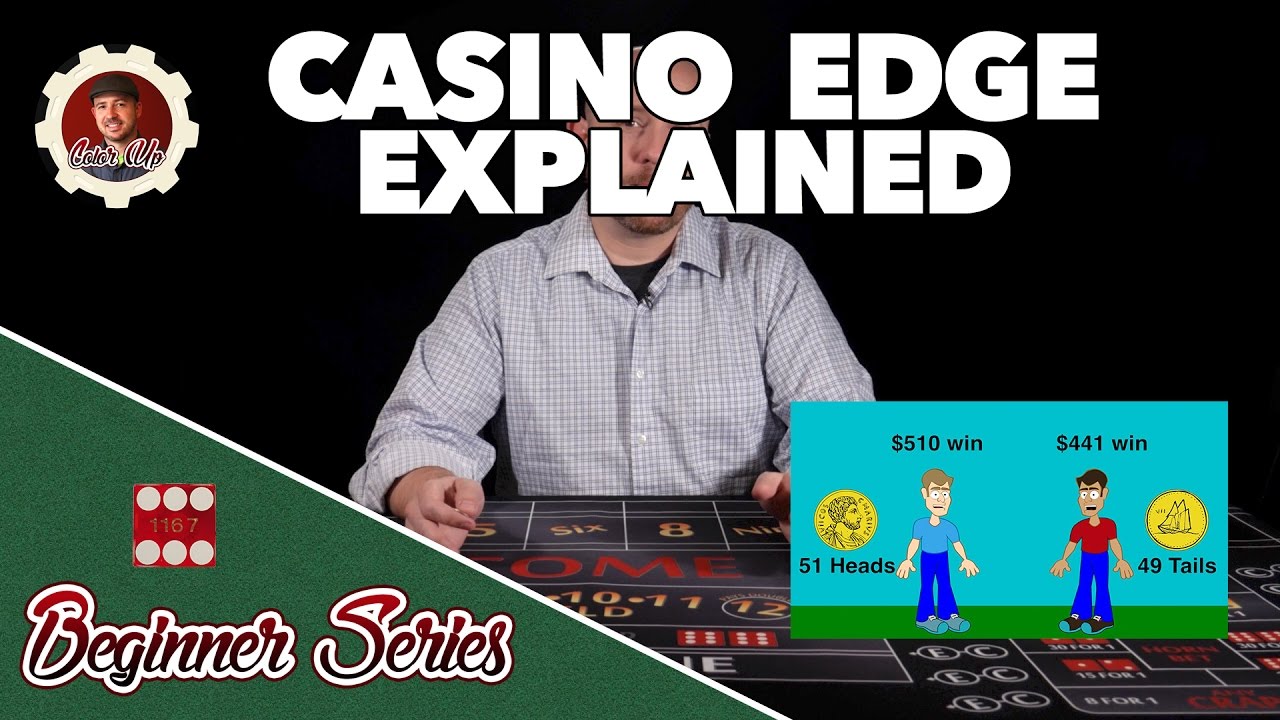
- The house edge is represented as the average percentage of your bet that the casino will keep. A game with a payout percentage of 95%, for example, has a house edge of 5%.
- Roulette comes in 2 main versions—single zero and double zero. The double zero version of roulette is predominant in the United States, and the house edge for that game is 5.26%. By removing one of the zeroes, the casino reduces the house edge to 2.70%. Slot machines have a house edge that varies based on the PAR sheet for the game.
- The House Edge is a term used to describe the mathematical advantage that the gambling game, and therefore the commercial gambling venue, has over you as you play over time. This advantage results in an assured percentage return to the venue over time, and for you an assured percentage loss of what you bet.
House edge is what makes casinos their profit. Each game has a small percentage built into it, ranging from less than 1 to more than 7%. Players can win money over short periods, though in the long run the house will make a profit equal to the edges they have in.
Many slot machines and video poker machines feature a progressive jackpot. The jackpot increases by a small predetermined amount each time the game is played. Often multiple machines are pooled or linked together to form a larger progressive jackpot which grows more quickly because more non-winning plays can be counted toward it.
Many lotteries feature progressive jackpots. After each drawing in which the jackpot is not won, a large amount of money is 'carried forward' to the jackpot for next drawing.
Progressive jackpot meter[edit]
The amount of the jackpot increases by a small amount for every play on any connected machine. The amount by which the jackpot advances is set by the casino ('the house'). A machine offering a progressive jackpot usually displays the amount of the jackpot, rather boldly, to attract players. After a player wins the jackpot, the jackpot resets to a preset minimum level.
For example, on a machine whose house edge is 5%, a generous jackpot contribution might be 1% (one fifth of the expected profit). The house is prepared to contribute some of the profit of a jackpot linked machine because players are attracted by the:
- relative novelty of progressive jackpots (generally, only a small fraction of the house's gaming machines will be connected to a progressive jackpot)
- constantly changing meter, often displayed on large LCD or LED displays
- large amount of the jackpot, which eventually motivates more players to play the game.
Qualifying[edit]
Usually the progressive jackpot is only offered to players who wager the maximum number of credits per play. All wagers, whether or not they are maximum-credit bets, contribute to the jackpot. As a result, a game which requires a 10-credit wager to qualify for the progressive jackpot tends to have its progressive jackpot rise to higher levels (relative to its break-even level) than a game that requires only a 5-credit wager to qualify.
Usually the jackpot can only be won by winning the combination with the highest payoff, e.g. a royal flush at a video poker game, or five of the most valuable symbols (lemons, cherries, alligators, etc.) on a slot machine.
Often, the displayed amount of such jackpots includes a base payout which is often simply the regular payout for the winning combination multiplied by the minimum qualifying bet. If the jackpot is 'reset' to this amount each time it is won then in essence the house is not providing any 'seed money' for the jackpot since the minimum that can be won in such a case would simply be the amount the player would normally be awarded for the jackpot-winning combination.
'Mystery' or 'must-hit-by' jackpots[edit]
A variation of the standard progressive jackpot is the 'must-hit-by' jackpot, which has substantial differences compared to traditional jackpots.
The value of every 'must-hit-by' jackpot is determined immediately after the preceding jackpot is won by a random number generator and stored within an encrypted computer connected to a gaming machine (or, more commonly, a network of machines) and is publicly disclosed to be within a certain range (for example, a small jackpot might be programmed to pay out at between $1,000 and $3,000). The jackpot pays on the wager that causes the jackpot to reach or exceed the threshold, with the maximum value within this range being the 'must-hit-by' amount.
Often such jackpots encompass a variety of games, with each game contributing a small percentage of wagers to the jackpot. Thus, these jackpots are often billed as 'mystery jackpots' since the conditions that cause them to be paid do not depend on achieving any specific result in the main game. Furthermore, it is not usually necessary to bet the maximum amount possible (or, often, to even bet any minimal amount above the minimum wager allowed by the software) in order to win a 'mystery jackpot' - although since it is a percentage of each wager that goes into the jackpot the odds of winning on a particular spin are usually in proportion to the amount of the bet. Or, to put it another way, one spin for twenty dollars would have the same odds of winning the mystery jackpot as twenty spins for one dollar each would, and also the same odds of winning the jackpot as would four hundred spins for five cents each.
Often, such games have several 'mystery jackpots' that usually differ by at least an order of magnitude both in terms of magnitude and frequency of payout, which can ensure that jackpots are seen to be won frequently (often, many times per day in the case of relatively small jackpots). One variation of this scheme (most often used by gaming corporations serving brick-and-mortar establishments over a large geographic footprint) is to have one main jackpot, several intermediate jackpots paid at the regional level, smaller jackpots paid at the site level and/or the smallest jackpots tied to each individual machine.
From the house perspective, a key financial consideration of such jackpots is that the portion of players' wagers directed to the jackpot are, in essence, only funding the portion of the jackpot within its specified 'range.' The gaming operator needs to fund each jackpot's minimum amount from the house edge of the main game, which is usually at least a third of the 'must-hit-by' amount especially in games with multiple jackpots as this creates an assurance that each jackpot will always be several times the value of the jackpot 'below' it. If the random number generator gives each value within the jackpot 'range' an equal chance of being the 'winning' value then under these conditions 'seed money' from the house would likely account for over half of the jackpot's total funding, for which the house would presumably need to compensate by increasing the house edge of the main game.
To counteract this issue and increase the average amount wagered before each jackpot is won, the mathematical formula used to calculate each jackpot is often skewed in such a way that makes it likely the actual average and median jackpots will be well above the average of the published minimum and maximum values. A simple example formula that would achieve this (expanding on the aforementioned example) would be simply to calculate the jackpot as being $1,000 plus the square root of a random number between zero and four million, which would result in a 75% probability of each jackpot being between $2,000 and $3,000 and a 25% probability of a jackpot being between $1,000 and $2,000.
Break-even point[edit]
In some games such as video poker, blackjack, or Caribbean stud poker, it is possible to compute an optimal playing strategy based on the average payoff (the amount of payoff times the chance of payoff). Because the jackpot of a progressive game constantly grows, it sometimes exceeds the break-even point for players, such that the jackpot wager becomes a 'positive expectation bet' for the player, with an average return to player (RTP) of greater than 100%. When the progressive jackpot is less than the break-even point, there is a negative expected value (house edge) for all players.
In the long run, with optimal strategy, a player can profit by only playing progressive games when their jackpots are above the break-even point, although the 'long run' can be quite long, tens of thousands of plays.
The break-even point cannot be easily calculated on a slot machine game, because the payback percentage for the game is normally unknown to the player. The break-even point in poker-based games can be calculated because the payback percentage for the game is a function of the paybacks and odds of the poker hands, which is based on a standard 52-card deck. The return of a slot machine is based on the published paytable, but also on the normally unpublished reels. For a five-reel slot machine, the player would need to know each symbol on each of the slot machine's five reels in order to calculate the odds. For a three-reel slot, the reels are normally weighted, and this would not be possible. However, in some circumstances the manufacturer may publish the payout of their machines.
Many online casinos allow the same game to be played in multiple currencies, in which case the break-even point and average return to player can change depending on the player's currency choice. This is because the jackpot amount may be converted between currencies so that the same amount is paid out to the winner no matter their currency choice, but the wager required to qualify for the jackpot is not. For example, consider a game that pays a $1000 / €900 / £700 jackpot, but requires a fixed $1 / €1 / £1 wager to qualify for the jackpot. In such cases, it is beneficial for the player to play in dollars, as the qualifying wager is a smaller proportion of the jackpot. Thus the break-even point will always be lower and the return to player will always be higher while betting dollars.[1]
Advantage play[edit]
Advantage players, who only play when the progressive jackpot provides them with a positive expectation situation, still generate revenue for the casino. Even though the player has an advantage over the house, the casino still profits from each play, because the bulk of the progressive jackpot has been pre-paid by the prior non-winning players.
Advantage gamblers sometimes organize teams of players to play machines where the progressive jackpots generate a positive expectation situation. Such teams often displace ordinary players, making the machines unavailable just when they are the most attractive to gamblers generally. Team members often have cell phones and work in shifts, calling a teammate to replace them when they're ready for a break. Some casinos have a policy of 'no team play', and will eject players suspected of playing on such teams. Such tactics do not work at online casinos because there are effectively an unlimited number of duplicate machines for players to play at, so the game cannot be monopolised by one player or small group.
Player's clubs[edit]
Most casinos offer slot clubs, which pay back a percentage of a gambler's wagers on their games in the form of cash rebates or other perks with a monetary value. Participating in a slot club can reduce the break-even point of a progressive jackpot game because of the value of the rebate on each wager.
Other jackpot games[edit]
Progressive jackpots are not limited to slot machines and video poker. Poker games sometimes include a progressive bad beat jackpot. Caribbean stud poker is another casino game which often has a progressive jackpot available, and some online casinos offer progressive versions of blackjack, roulette, and other casino games. Many lotteries feature progressive jackpots.
Progressive blackjack[edit]
A progressive blackjack game usually does not differ from conventional blackjack, apart from the addition of an optional side bet which gives the player a chance to win a progressive jackpot. The side bet wins if the player is dealt one of several specific card combinations such as four suited aces. The awards can range from several dollars up to 100% of the jackpot depending on the different card combinations, and the winning hand paytable can differ between casinos.[2]
Progressive jackpot records[edit]
Developers of progressive jackpot machines have been competing for the highest prizes since their inception. Microgaming, an online casino services providers, host a jackpot system which is cross-product, where multiple games contribute to the pool.[3] On the 28th of September 2018, a record jackpot was won on their game Mega Moolah totalling €18,915,872, which exceeded the previous record by approximately 10%.[4]
The previous record win had been held for over five and a half years by another progressive jackpot game called Mega Fortune, which is developed by casino software provider NetEnt. The total win on that occasion was €17,861,800. Interestingly, this is the third time that the world record has changed hands between these two games since 2011.[5]
In-House Jackpots[edit]
The In-House or Proprietary Progressive slot machines are the group of devices or programs that are linked together. These machines and applications are owned as well as operated by the land-based casino or its online variant. The progressive jackpots on these slot machines are not multi-million-dollar, but the winning prize is considered a substantial win. The In-House or Proprietary Progressive machines are most often hit compared to wide-area progressive jackpots.[6]
See also[edit]
References[edit]
- ^'Jackpots with known break-even values'. CasinoListings.com. Retrieved 2015-03-18.
- ^'Blackjack Side Bets'. WizardOfOdds.com. Retrieved 2015-03-18.
- ^'Progressive Jackpot Slots'. Holy Moly Casinos. 2017-10-29.
- ^'Mega Moolah Record Win » New Casino Sites'. New Casino Sites. 2018-10-09. Retrieved 2018-10-09.
- ^'Progressive Jackpot Slots - Win Millions! | CasinoGuide'. www.casinoguide.co.uk. Retrieved 2019-04-17.
- ^'Slots 43: Types of Progressive Jackpots and Definitions'. In-House Jackpots. 2020-04-19. Retrieved 2020-08-09.
The house edge is a percentage reflecting the advantage that
a particular casino game has over the player. It is not,
however, the ratio of money lost to the total wager. Instead, it
indicates the average loss to the original bet, making it
simpler for the customer to estimate their expected losses
during a single hand or gaming session.
The higher the percentage, the larger the advantage for the
house. If a player were to place an initial wager of $100 on a
game with a 0.28% house edge, then they could expect to lose 28
cents. On a game with a house edge of 4%, that same wager would
lose $4.
That may not sound like much of a profit for the casino, but
consider that the doors to these establishments are open 24/7.
Every minute of the day, the casino is raking in 0.50% here and
12% there. All these figures add up over time, which is why the
gambling mecca of Macau brought in $45.27 billion in gross
revenue in 2013.
Why Casinos Don’t Cheat
Assuming that you understand the house edge and what it
represents, this mathematical percentage should also serve as
the most compelling piece of evidence against casino fraud.
Legions of bitter gamblers swear that casinos resort to
underhanded means to take their money. In reality, this is
nothing more than a defense mechanism meant to compensate for
bad luck and poor strategy.
Simply put, casinos don’t need to cheat to get your cash.
They have an inherent advantage thanks to the rules of the game
and payout odds (which always differ from the true odds). While
some players might experience short-term success or even walk
away as instant millionaires, most gamblers are going to wind up
losing more than they win. This is why gaming establishments
continue to flourish, despite the efforts of advantage players
and an increasingly savvy betting public.
The House Edge for Casino Games
House Edge Casino Games
Casino games come in a wide variety, but you can be certain
that all of them have been carefully designed to give the house
an overall advantage over the players. The edge for some games
is fixed, while others vary depending on factors such as deck
size and rules. This section includes the house advantage for
some of the most popular casino games currently being offered
around the globe.
Baccarat
The edge is 1.06% when betting on the banker, and
it’s 1.24% when wagering on the player. If the tie option is
chosen, the edge increases to 14.36%.
Blackjack
When playing with liberal Vegas rules, the house
edge 0.28%. This includes the dealer standing on soft 17, late
surrender, resplitting aces, doubling after splitting, and
doubling down on any two cards.
Caribbean Stud Poker
The house edge on this card game is
5.22%.
Casino War
The edge is 2.88% when you go to war on a tie.
If you choose to surrender on a tie, the edge is 3.70%. When you
bet on a tie, the edge increases to 18.65%.
Craps
This popular dice game has a wide array of bets,
often with a different house edge for each. The worst bets are
any seven (16.67%) and two, twelve, and all hard hops (13.89%).
Pass/come has an edge of 1.41%, while don’t pass/don’t come is
slightly better at 1.36%. Taking odds on four or ten, five or
nine, or six or eight all carry a house edge of 0.00%, which
makes these some of the best wagering opportunities from any
casino game (although the player must also pair this with a
negative expectation wager).
Game of Keno
This lottery-style game has a terrible house edge that
usually ranges from 25% to 29%, making it one of the worst
casino wagers. However, the potentially large payout ensures
that bettors still flock to it.
Pai Gow
The popular Asian domino game has a house advantage
of 1.50%.
Pai Gow Poker
The card game version of the Chinese classic
carries a 1.46% edge.
Roulette
The European version with the single zero has a
casino advantage of 2.70%. When the 00 is added for the American
version, this advantage increases to 5.26%.
Sic Bo
Depending on which bets you’re placing, Sic Bo has a
house edge of 2.78% to 33.33%.
Slot Machines
The house edge on slot machines ranges from
2% to 25%, but it’s almost impossible to gauge what the house
edge is on the specific machine you’re playing.
Spanish 21
The edge is 0.76% when the dealer hits on a soft
17, and this lowers to 0.40% when the dealer stands on a soft
17.
Three Card Poker
The PairPlus option carries a 7.28% edge
for the casino, while choosing to ante and play results in a
3.37% edge.
Video Poker
The traditional Jacks of Better version of the
game with full pay has a house advantage of 0.36%. In a few rare
cases, some video poker machines played with perfect strategy
actually give the player a slight edge over the casino.
Hourly Expected Loss
One way a gambler can use the house edge is to calculate the
cost of their entertainment. And that’s exactly how a gambler
should view casino games, too—as a form of entertainment with a
cost. It’s not enough to know the house edge on a game, though.
You also need to know your average bet size and the average
number of bets you’re going to make per hour.
Once you have that information, you can just multiply all
those factors together in order to get the average amount of
money you can expect to lose per hour. This won’t resemble your
actual losses until you start getting a lot of hours under your
belt, because anything can happen in the short term. But it’s
still not a bad idea to have some idea of how this works.
Here are some examples.
Baccarat
If you stick with the banker bet, you’re looking
at a 1.06% house edge multiplied by an average bet of $100 and
an average number of bets per hour of 80, you’re looking at an
expected loss per hour of 1.06% X $100 X 80, or $84.80.
Blackjack
Depending on how many players are at the table,
blackjack plays at a similar pace to baccarat. If you’re the
only player at the table, you might see as many as 200 hands per
hour. But with a couple of other players at the table, you’re
looking at more like 80 hands per hour. For this example, we’ll
assume 80 hands per hour at $100 per hand and a 0.28% house
edge. Your expected hourly loss is $22.40. Keep in mind that you
need to use perfect basic strategy to achieve this expectation.
Caribbean Stud Poker
Caribbean Stud is a slower game than
blackjack. You might see 50 hands per hour. Assuming $100 bets
at a 5.22% house edge, you’re looking at an hourly loss of $261,
even with the slower pace of the action.
Casino War
You can estimate 65 hands per hour at Casino
War. Given a 2.88% edge and an average bet size of $100, you’re
looking at an average hourly loss of $187.20.
Craps
With craps you can expect to see around 50 rolls per
hour. The calculations for the hourly loss are a bit more
complicated with this game though, because most of the commonly
placed bets are not decided in a single roll. If you were
playing the pass bet on every roll, for example, you’d expect
that bet to be settled around once every 3.4 rolls. So at 50
rolls per hour, it would be settled about 15 times per hour. The
house edge of this bet is 1.41%, so you’d expect to lose $1.41
per settlement over a $100 wager. With 15 settlements an hour,
that equates to an expected hourly loss of $21.15.
Game of Keno
Keno’s huge house edge of between 25% and 29% makes it
look like one of the worst bets in the casino, and in a sense,
it is. But in terms of hourly expected loss, it’s probably
better than you think. That’s because most people don’t bet $100
on keno at a time—they usually only bet a dollar. And they might
only make between 6 and 12 bets per hour. Call it 12 bets an
hour at $1 each, and your expected loss is only $3 or $4.
Pai Gow
This game has a relatively low house edge of 1.50%,
but what’s really attractive about it, from an expected loss per
hour perspective, is how slowly it plays. Even at $100 per bet,
you’re only making 40 bets per hour, which is $4000 in action
per hour. 1.5% of that is $60.
Pai Gow Poker
Like the original tile based version, we’re
looking at a relatively low house edge and a slow placed game.
The 1.46% edge is slightly better, but the game plays just a
tiny bit faster with cards instead of tiles. You’re still
looking at about $60 per hour if you’re playing for $100 per
hand.
Roulette
The European version has a 2.70%. You shouldn’t
play any other version, because you can almost always find a
single zero wheel if you’re just willing to do a little bit of
looking around. Like the Pai Gow games, you’re only looking at
40 hands per hour or so. At $100 per bet, that’s $4000 in action
and $108 per hour in expected losses.
Sic Bo
Sic Bo is a little bit faster than Pai Gow or
roulette, but only just. You’re talking about 45 bets per hour.
If you stick with the best bets, which have a house edge of
2.78%, you’re looking at an expected hourly loss of $125.
Slot Machines
We’ll assume a 10% house edge, although you
might find looser games than this. But slots is a fast paced
game. You’re talking about 600 spins per hour. Most slots
players don’t bet $100 per spin, but if you did, you’d be
looking at a massive hourly expected loss of $6000. Even if you
only play for $10 per spin, you’re looking at $600 per hour.
Spanish 21
Like blackjack, you’re looking at 80 hands per
hour. Assuming $100 per bet, that’s $8000 in action per hour.
0.40% of that is $32.
Three Card Poker
This game plays faster than you might
think. You can assume 70 hands per hour at $100 per hand. With a
3.37% edge, you’re looking at an expected loss per hour of $235.
Video Poker
The house edge for full pay Jacks or Better is
0.36%, but you’re looking at 600 hands per hour. Chances are you
won’t be putting $100 into action on each hand; $5 per hand is
more likely. That’s $3000 in action per hour, and 0.36% of that
is only $10.80, making this one of the most affordable types of
casino entertainment you’ll find.
Summary
Casino House Edge Percentages
The house edge has existed for as long as land-based casinos
have been around, and it’s been refined over the centuries to be
as efficient as possible. Its sole purpose is to ensure that
gaming establishments have a long-term advantage over their
customers, something which is necessary for the continued
operation of any casino.
Games such as slot machines and keno provide a larger
advantage for the house, although their potentially sizable
payouts ensure that customers keep coming back for more. This is
especially notable in the case of slots, as their 2% to 15% edge
hasn’t prevented them from being the largest revenue generator
at casinos around the globe.
Under the right set of circumstances, the house edge can be
marginalized or even turned to the player’s favor. This is
possible in video poker or certain wagers in craps, although the
random nature of such games still doesn’t guarantee a long-term
profit.
Lowest House Edge Casino Games
The best tactic for a gambler is to accept that the odds are
stacked against them. Once this realization sets in, you can
concentrate on enjoying yourself, which should be the main
reason for visiting a casino in the first place.